Thursday, January 26, 2012

The Great Circle

--The aerial northern “Great Circle” route in the headlines follows much the same transatlantic route used by early Keltic as well as Nordic seafarers.


Every Xmas, the press run some inane Santa tie-in story, such as NORAD is tracking his sleigh. This year it touched on a new “Santa’s shortcut” air route crossing the Arctic Circle allowed by changing airline regulations. This may or may not really be news, but the transatlantic ‘shortcut’ route cutting across the Arctic is certainly not a new idea. Just as today’s Santa is the development of an ancient idea [see books by Phyllis Siefker, Paul Frodsham, Tony Van Renterghem, etc], the ‘Santa’s shortcut’ route continues an ancient practice as far as transatlantic crossings go. Now you may wonder, looking at a standard map, why would an airliner from, say, New York to London be flying over Greenland in the first place? Why not just fly a straight E-W route? (In fact, NYC is southwest of London, the Titanic took this south-westerly route – though it didn’t save it from an iceberg.)


The answer lies in the deceptive standard map projection: plot the shortest course between, say, NYC and London on a globe with a piece of string, and you will find it skirts Iceland and traverses Greenland, crossing in and out of the Arctic Circle. Similarly, the route will show as a straight line on a ‘gnomonic’ map projection, a more accurate map projection, ironically said to be the world’s oldest, created in the 6C BC by the Greek scientist Thales.

But because this route appears as a curve on a flat Mercator-style map projection, it’s called a Great Circle Route. The airlines all follow Great Circle Routes and if you’ve never made the transatlantic crossing by air during daylight hours, get a window seat: take my word, I’ve made the trip several times, it’s well worth it for the view of the immensity of the North Atlantic (often littered with icebergs), Iceland and a whole slice of the Arctic Circle.

In fact, airlines have to fly a slight zigzag pattern over their GCR to maintain compass headings for set times, just as sailing vessels do, whether or not they are ‘tacking’ into head winds. And regulations requiring airliners to keep within x minutes of a place to land if need be, reflect the way sailors steer bearings that take them past a series of safe havens. In previous blog posts, we’ve discussed the importance of a type of ancient, carefully guarded, codex called a periplous, which was essentially a ship captain’s directional guide to a series of landfalls en route. And while it’s been assumed early seafarers didn’t have proper compasses, recently it’s been argued that they may have used the ‘sunstones’ referred to in the Norse sagas – crystal rocks which refract light differentially). However if you look at a map, the need to keep within a day’s sail (the Norse called this a doegr) of a harbour would take these vessels northward in any case, for the only landfalls for the North Atlantic crossing are up towards the Arctic Circle.


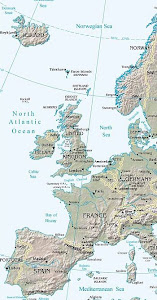
This fortunate coincidence, that the shortest route also has harbours more or less en route, allowed ancient Keltic and Nordic seafarers to cross the Atlantic. This so-called 'northern stepping-stone route’ arcs up NW from northern Britain or Scandinavia, past the Orkney Isles, passes within a day’s sail of the Shetlands, and then the Faeroes. There follows a dangerous open-water passage, NW over to Iceland, then the route heads NW again to make the shortest passage to the next landfall, SE Greenland, across the narrows of the Denmark Strait. There, midway once stood a lost land: a small group of habitable islets, now drowned by rising waters, called Gunnbjorn's Skerries. The sailing route then turned SW down Greenland’s east coast (helped by the current), continuing SW to landfalls on the North America continent, the closest of which is the tip of Newfoundland.


That this route was much used by early seafarers is not just a matter of map observation, for traces of Keltic and Nordic settlement have been found along these routes. The Nordics’ presence is well known, from the naming c980 AD of Greenland by Erik The Red (who should really have been called Erik The Ready Wit), through their use of Iceland as a base (attested in sagas) to the 1960s re-discovery of the ‘Viking’ settlement at L’Anse Aux Meadows on the northerly tip of Newfoundland, now a UNESCO World Heritage Site. That site, possibly settled by Erik’s son Leif Ericson, is usually identified as the land known in the Icelandic sagas as “Vinland the Good” (Vinland meaning Wine-Land) as it was then below the northerly limit for wild native grape-vines to grow (some identify Vinland as Nova Scotia). The search is still on for the sagas’ ‘Helluland’ (not an Erik The Red witticism, just Erik The Red’s son Leif Ericson’s ad hoc place-name, Old Norse for ‘Flat-Stone Land’ – possibly Baffin Island or northern Labrador) and Leif's ‘Markland’, meaning ‘Forest-Land’ which Leif also visited (somewhere farther south below the Arctic tundra/taiga treeline – possibly southern Labrador).

What is less well known, and is our concern here, is the presence of the earlier Keltic seafarers along this route. The orthodox view is that the Keltic presence which is found in Icelandic DNA etc is the result of Viking raiders taking slaves – mainly capturing Scots or Irish women to breed with. However the Nordic sagas themselves acknowledged the presence of earlier Keltic seafarers, referring to a land called Whitemansland (Hvítramannaland), or Irland-Mirka. This latter translates as Ireland-the-Great, usually rendered just as Greater Ireland. It is usually identified as Greenland, the idea being that there were Irish monastic settlements along the southerly coasts here. Its other name, Whitemansland, was taken from a native appellation for a land where (a native told the Norse) men in white robes processed carrying long poles with banners of white cloth and chanting loudly. They had "hair and skin as white as snow" and Whitemansland is sometimes translated Palefaces’ Land, paleface being a native term for the invading whites which survived in Hollywood-western Indian-speak, for what that’s worth. (Their white hair indicates older men, and another account says they wore a fringe, the shaved-pate effect which is the priestly tonsure in some orders.)

Early accounts exist in Latin as well as Icelandic Norse, and the terms used there are Hiberni (Hibernians, i.e. Irish), or Albani/albani, which can mean white men [when not capitalised] or men of Alban, a term for Britain [Greek Albion] and later in Gaelic sources for non-Romanised northern Britain. These are not just terms of origin, with Greater Ireland being translated as either Hibernia Major or Albania, suggesting more than just transient settlements. (The first Norse settlement in Iceland is dated to the reign of Pope Adrian, AD 772x795] while Greenland was first settled 986, by Eric The Red’s son Leif; the Norse abandoned their settlements in Greenland etc in the climate downturn of the 14th/15th Centuries.)


Here’s a quote from the first chapter of the Landnámabók, ‘The Book Of The Settlement Of Iceland’, which opens with how The Venerable Bede (historian and father of the English Church, fl. c.730) refers to old books that describe a land called Thule, ‘said to be six days' sailing north from Britain’, where ‘day came not in winter, nor night in summer’ (meaning it was above the Arctic Circle).

… before Iceland was peopled from Norway there were in it the men whom the Northmen called Papar; they were Christian men, and it is held that they must have come over sea from the west, for there were found left by them Irish books, bells, and croziers, and more things besides, from which it could be understood that they were Westmen [Irish]; these things were found east in Pap-isle and Papyle, and it is stated in English books that in those times voyages were made between these countries.

Do we have any Celtic codex sources on this presence? Sadly, there’s nothing that has survived quite like the Icelandic sagas, which are a distinct literary genre of historiography that developed as a written form after the Viking Age. De Mensura Orbis Terrae, a c825 geographical text by the Irish monk Dicuil (who may also be the anonymous Irish poet known as “Hibernicus exul”), describes the presence of a party of Irish monks who spent half a year on the farthest-north destination island of “Thule,” which is usually identified from details about the midnight sun as Iceland, but could be other sites to the east or west. With the Norse accounts that refer to these ‘papar,’ meaning fathers in the sense of priests, and place names like Pap-isle, are there not any more detailed matching Celtic church legends of far-flung anchorite colonies?


Legenda, meaning in Latin that which is to be read, were a then-popular ecclesiastical genre concerning saints’ lives - though unfortunately not reliable as historical accounts, the focus being on the fantastic and miraculous events the saint was involved with. Here, we do have a 8th C. composition, the Navigatio Sancti Brendani Abbatis, the Voyage Of Saint Brendan The Abbot, a strange legend concerning Irish seafaring monk St. Brendan The Navigator (one of the Twelve Apostles of Ireland), who sailed westward in a leather-and-woodframe currach c550 AD in search of the ‘Promised Land Of The Saints.’ A currach [spelling Anglicised as curragh; not to be confused with the small round Welsh coracle] is a Celtic seagoing-longboat design of unknown antiquity, but the associated boat-building skill is maintained in a few remote parts of the Gaeltacht [Gaelic-speaking area of western Ireland]. That it was possible to sail such a [twin-masted] currach across the north Atlantic, from Ireland to Newfoundland via Iceland, was demonstrated in 1976-7 by Tim Severin, in The Brendan Voyage, the title of a subsequent book and tv documentary. (Despite what you see in films, and the occasional reconstruction sailing voyage from 1893 onward, the Viking Norse didn’t use their dragon-prowed longships to cross the stormy seas, but a class of small merchant ship called knarr or knorr; I’ve read that the lifting action of Atlantic waves could break the back of a flat-keeled longship if one wave caught the bow and the other the stern.)


Even if St Brendan’s Navigatio was factually based, the actual route he and his fellow monks might have taken remains a matter of argument, for most of the legend’s strange encounters do not easily lend themselves to modern rationalising that would turn them into an account of an actual voyage or voyages past the Faeroes to Iceland and beyond (some argue all the way to Newfoundland). The Navigatio belongs to a then-popular type of marine wonder-tale genre known generically in Celtic as immram, and so incidents may have been copied from earlier now-lost instances. Tim Severin’s book, an international best seller, details his own route-rationale, which he explored with a 4,500-mile test voyage in his makeshift replica curragh; others have made their own research attempts on an armchair-travel basis using maps, ruler, compasses and textbooks. This has the advantage of tracing a set of different voyages which St Brendan may have made as the model for the tale as a composite adventure.
(The basic information is now all online, for anyone else who wants to have a look at it, starting with an English translation, here.) Of course, the Navigatio Sancti Brendani may be compiled from accounts by other papar, like Cormac, another Irish monk who is mentioned in Adomnán’s c700 Life Of St Columba as an intrepid sailor who went where no other had, over the uncrossable ocean to the north, but of whom we hear nothing more beyond Adomnan’s account.

More generally, regarding the problem of the lost discoveries and settlements by Keltic pioneers, one writer who has done ongoing field and literary research over several decades is veteran Canadian author Farley Mowat, who has written a series of books on this research area, culminating in his 1998 The Farfarers: Before The Norse (also issued in the UK as The Alban Quest: The Search For A Lost Tribe,1999). Mowat argues some sites classed as Norse really belonged to the Celtic seafaring settlers of North America he calls the Alban - largely the remnants of the Armorican tribes of Brittany enslaved by Caesar and later Picts from the Orkneys, driven ever westward by the advancing Norse. Mowat’s work is regarded by ‘serious’ historians as over-imaginative (he uses novelist’s techniques to add picturesque details), but academic research into such early transatlantic contact, which promotes the notion of multiculturalism, has of late acquired a certain respectability and impetus with a Worldwide Atlantic Conference in 2009, whose motto was, inevitably, 'Columbus was not first', and related pre-Columbian archaeo-finds such as this.

A less academically-respectable but separate longstanding line of enquiry by others has pursued the legend of a later (but still pre-Columbian) seafarer, the Welsh Prince Madoc discovering land to the west in 1170, and returning to Wales to escort a large fleet of colonists there. When the first American overland explorers crossed into the Ohio Valley, they discovered a tribe of native people called the Mandan, who they said bore odd similarities to the Welsh, in language as well boat-building style (round coracles on the Welsh pattern). This included the artist George Caitlin, who painted the coracle-like Mandan bull boat [pictured]. Sadly, the Mandans’ civilisation was almost wiped out by smallpox in the 1830s, right after Catlin visited.


But the controversy has continued ever since, the Welsh-Mandan claim being disputed as crypto-racism, or flagged up as English propaganda going back to the Tudor kings (Tudor was a Welsh name, Tewdr) to extend English geopolitical claims farther south, from the 16th century onwards. Hakluyt’s famous ‘Voyages’ even had Iceland seized for England by the fleet of mighty King Arthur – who even if real would scarcely have been English himself, but was adopted by the Welsh Tewdr/Tudor dynasty as a propaganda tool; Hakluyt was recycling and updating a part of Geoffrey of Monmouth’s 1135 (pre-Madoc) mythmaking Arthurian opus the Historia Regum Brittanorum, to promote English gains in the New World by Raleigh et al.) Although it got nowhere academically (though there is a U. Of Wales scientific research vessel called Prince Madoc) or politically (beyond local speculative commemorations), the Madoc story has lived on in literature.


For those interested in the Arthurian legend, this later northern-route tie-in to the legend has added a distinct subgenre of this subject area. This is based on the notion that the original legendary “isle of apples” Avalon, where Arthur was taken when mortally wounded and possibly also where the Holy Grail with its healing power was kept, was based on somewhere across the North Atlantic, some real island or peninsula on North America’s east coast, which a Celtic religious order used as the ultimate secret retreat. Like the Promised Land of the Saints, the Celtic Otherworld, after all, was somewhere to the West – perhaps it was a real place, a secret burial isle, perhaps a place of convalescence a wounded hero, if fortunate, might one day return from, or at least retire to, living out his days in peace?

Various writers have entertained the New World Avalon thesis, dating back at least to Arthurian-Glastonbury author Geoffrey Ashe in Land To The West, 1963, focusing on St Brendan’s voyage. Later entries, post the bestselling Holy Blood, Holy Grail, are more conspiracy-oriented, focusing on the Templars, Freemasons and related ‘hidden-history’ cover-ups: Michael Bradley in Holy Grail Across The Atlantic, 1988, Andrew Sinclair in The Sword And The Grail: The Story Of The Grail, The Templars And The True Discovery of America
, 1992, and Graham Phillips, in Merlin And The Discovery Of Avalon In the New World, 2005 [feature and cliff-hanging Ch. 1 online here and here). This is not entirely a new inspirational idea: there are Avalon place names on the map of eastern Canada in Newfoundland, notably the Avalon Peninsula, named after England’s official Province of Avalon colony, designed and given a Royal Charter in 1623 as a Glastonbury-style religious refuge (sadly, the long winters proved too much for the intended farming commune).


The ultimate goal in these early nor’westerly voyages of exploration was distant Thule, whose popular appellation in Latin (thanks to the poet Virgil) of Ultima Thule indicated it was believed to be the most northerly limit of land in the world. Today, we know this limit would be the north coast of Greenland, which is never approachable by sea except by modern icebreaker vessels. (The US built an airbase nearby which they called Thule.) But from descriptions of visits by various sailors (including Columbus) giving lengths of daylight, ancient Thule is usually taken to be Iceland, on the edge of the Arctic Circle – although again it could be lands east or west at a comparable latitude. (As Dava Sobel‘s 1996 bestseller Longitude details, establishing one’s E-W longitude remained a problem for mariners well into the 18C.)


The earliest visitor to write an account of visiting Thule for Greco-Roman readers was Pytheas c325 BC, who said he sailed there, near the edge of the congealed sea. Inevitably he was denounced as a liar, mainly by the Roman geographer Strabo (who never visited), and his book Peri Tou Okeanou (‘On The Ocean’) was lost to posterity (we have only passages quoted by others like Strabo). Pytheas was from Massilia, the modern Marseilles, then a Greek colony in the western Med offering trade access to mainland Gaul and points beyond, and this raises the prospect that Pytheas, who was a private citizen rather than an official, travelled with the help of local sailors, perhaps first from Gaul and then from Britain, who knew the north Atlantic trade routes.


In modern times, the surviving references to Pytheas’s lost book have allowed a re-appraisal by scholars such as Rhys Carpenter (Beyond The Pillars Of Hercules, 1966) and Prof Barry Cunliffe (The Extraordinary Voyage Of Pytheas The Greek, 2001). I have both these books and they definitely concur that Pytheas’s observations (which include latitude measurements using a gnomon or sundial-type calibrated measuring stick) are reasonable even if not that accurate. I suspect ‘Thule’ [pronounced Tooley] however was an obsolete pre-Keltic and then a poetic classical name meaning simply the far-away [cf Greek tele, ‘at a distance’], and was attached by different map-makers to different islands and peninsulas, from Norway to Shetland, the Faeroes, Iceland and Greenland. Thus, no set of coordinates given or geographic description matches up with the next. As the subarctic island-stepping-stone trade route opened up, the symbolic name Ultima Thule for the farthest land retreated like a mirage, reassigned to the next potential landfall on the next generation of maps being made back home.

It’s quite possible the notion of yet-another unknown island was kept alive for its confusion value - disinformation to maintain secrecy over trade routes. Just last year a rare giant map parchment scroll 6.75 m long, the Tabula Peutingeriana, was put on display as the only example of its type to survive. This was drawn in the 13C but based on 4C and older Roman sources giving official itinerary i.e. highway-stopover info, for the entire imperial road network, showing how it reached out to the ends of the known world. You can see from the detail I’ve reproduced below, taken from the map’s NW top-left corner there is a string of 3 small unnamed islands leading westward from “Jbernia Ins.” [Hibernia = Ireland] and ending with “Thyle Ins[ula]”. The stretched-planisphere scroll format means that neither directions or distances shown are to be taken seriously. The Romans were such hopeless mariners that it is more likely the Ultima-Thule stepping-stone route shown here derives from 2nd-hand info, perhaps from the work of Pytheas himself, for no Roman expedition seems to have followed up his circumnavigations (hence the arguments lasting for centuries between Roman writers over the accuracy of his observations).


Thus, we’ve come full circle, back to where transatlantic map-making explorations began. Nevertheless, I would argue there is a reasonable supposition that Celtic mariners knew the sea route from mainland Europe as far northwest as Shetland (at 600 N.) and probably Iceland (and the pack ice of the Frozen Sea beyond) as far back as c325 BC, and may well have crossed all the way to the New World in their currachs.

What is needed is archeo evidence regarding the traces of early settlement along the route indicated above, by Keltic monastic refugees, traders, fishermen and whalers etc. Author Farley Mowat visited many such sites, compiling fieldwork notes largely from local reports, and his 1998 The Farfarers: Before The Norse aka The Alban Quest: The Search For A Lost Tribe, has original outline maps sketching in a large number of these possible sites. Copyright restrictions discourage me from reproducing them here, but the book is still available online, detailing Mowat’s arguments. For example, he felt that the roofless ruins found around these coasts are a reflection of an old Scots-Irish practice where you use your longboat as the roof of your shelter on such distant shores where no suitable trees etc are to be found locally; thus he argues L’Anse aux Meadows may be a Keltic site rather than a Norse one.


Sunday, October 09, 2011

Was Hamlet Celtic?

-- Did 'Hamlet' derive from an older, now-lost Celtic manuscript source?
A press story surfaced, or rather resurfaced, in August (cf picked up by the News For Medievalists blogsite 6-08-11) that the most famous character in Shakespeare was not Danish at all, but Irish. Or to put it another way, what is usually cited as English Lit’s greatest play was in fact of Celtic origin. As the original source would thus be a Celtic codex, it's within our remit to take a look at the controversy. This matter is also related to another longstanding controversy regarding Shakespearean authorship which is about to go wide with the release this autumn of a big-budget film about literary intrigues at the Elizabethan court, titled Anonymous.


Like most such press stories based on scholarship, the was-Hamlet-Irish story is not altogether new, being picked up by some papers earlier this year [cf "Was the great Dane Irish? That is the question," Guardian 3-3-11]. The press source seems to be an article in Oxford University Press's Review of English Studies (I can't find the article online) by a mediaeval Scandinavian scholar at Aberdeen University, Dr Lisa Collinson, who argues the name Hamlet derives from Dark Ages Irish literature.

Shakespeare's source is always given as a c1200 compilation, the Gesta Danorum (Deeds Of The Danes), by Danish scholar Saxo Grammaticus. But the story differs from the play in many ways, there's no other evidence Saxo's Vita Amleti was actually historically based i.e. that there was a real Prince Hamlet; and there is an older Scandinavian folktale of a similar-sounding hero called Amlothi. Supposedly Shakespeare got the "Hamlet" spelling from a then-current [c1570] French translation of Saxo. Dr Collinson argues the name derives from Admithi, which is found as the name of a walk-on character in the old Irish saga The Destruction of Da Derga's Hostel, part of the so-called Ulster cycle. (There was also a 10th-C king-slayer figure called Amhlaide in the Irish Annals, though Irish mh is pronounced more as v.) She says the Irish root refers to grinding and the Scands adapted this word a metaphor for the 'grinding' sea, grinding in the ancient sense of a quern-style millstone being turned to grind down wheat, or in this case presumably, boats. (The early-mediaeval Icelandic work the Prose Edda also quotes an old poem wherein a local name for the sea is Amloði's Mill.) Quite why the seafaring Scands would need to borrow a name from Irish legend for the sea escapes me, as they had their own terminology. We still have the wonderful Nordic-Germanic term maelstrom for a whirlpool-like effect at sea, literally a grinding stream. Like all oral (what we now call illiterate) cultures, they also had a rich poetic storytelling language, as did their Anglo-Saxon cousins of the Beowulf era who gave us metaphors (known as kenning) like "the whale's way" for the open sea.


But let's follow the argument, as reported, a bit further. There is an earlier [1969] academic 'fringe' text called Hamlet's Mill, a comparative-myths study which made an etymological argument that ancient myths have an astronomical 'key.' This is to do with the so-called precession of the equinoxes, an effect of the earth wobbling around on its axis so that the Pole Star is in a different astrological or zodiacal 'house' every 2,000-odd years, in a 12-part cycle completed every 25,000-odd years. It's a theory best known through popular culture, as in 'This is the dawning of the Age of Aquarius.' The two co-authors gave the name Amlodhi's Mill (or variants) to this astronomical effect, attempting to reconstruct a lost master-myth of a heavenly mill, run by Amlodhi the Titan, whose instability causes what we might call sea changes - great political and cultural changes – on earth. This work has always been a bit much for me to buy, with a £25+ textbook pricetag, but you can now read it (or a potted version of it) online free, here.

Now we have the added press confusion implying the original Hamlet was an Irish nobleman, which might make for a provocative press headline but misrepresents the underlying academic argument about the grinding sea. But if you don't buy the academic argument of an Irish etymological origin of Hamlet as astro master-myth, is that the end of the matter as far as a possible Celtic source goes? I would argue: not necessarily. There may be more to it.

Shakespeare evidently wrote more than one version of his play, and there is thought to be a lost original source, designated the Ur-Hamlet, which if it could be located would betray its sources in earlier literary works. (Shakespeare always based his plays on existing legends etc.) But even if we don't have the lost Ur-Hamlet, we still have clues pointing to a British - not Irish - source for much of the play's plot. Others better placed than me have made the argument that much of Shakespeare's Hamlet derives from an old British source, with comparisons made with other British mediaeval romances like Guy of Warwick and Bevis of Hampton. For instance the Encyclopaedia Britannica 1911 edition argued “The close parallels between the tale of Hamlet and the English romances of Havelok, Horn and Bevis of Hampton make it not unlikely that Hamlet is of British rather than of Scandinavian origin.” This theory does not appear in the modern EB and may seem just old-fashioned patriotism at work in 1911. The earlier sagas of course were formative-national in their outlook, so where a story is set is always significant. And while the play’s setting is limited to one place, a Danish castle, the older versions venture farther abroad. Even the earliest surviving Scandinavian version of the Hamlet legend oddly has him going to Britain and spending much of the story there. Here's the basic story from an older (note the now-strange names like Feng) surviving pre-Saxo Danish version, called in Latin Chronicon Lethrense and in English the Chronicle Of Lejre:

Then [king] Rorik ... set up Orwendel and Feng as rulers in Jutland. The king gave Orwendel his sister, for the good work he'd done. With her he had a son called Amblothe. Then Feng killed Orwendel out of envy and took his woman to wife. Then Amblothe devised a plan to save his life, and acted the fool. Then Feng was wary of Amblothe and sent him to the king of Britain with two of his servants and a letter saying Amblothe should be put to death. He scraped it off while they slept and wrote saying that the two servants should be hanged and Amblothe marry the king's daughter; and that's what happened. A year to the day, as Feng drank to the memory of Amblothe, he came to Denmark and killed Feng, his father's murderer, and burned all Feng's men in a tent, and so was king of Jutland. Then he went back to Britain and killed his father-in-law who wanted to avenge Feng's death. Then he took the queen of Scotland to wife. As soon as he came home, he was killed in battle.

In the play, Hamlet survives similarly when sent to Britain with a sealed death-warrant letter, but this takes place offstage, whereas in the earlier version[s], a considerable amount of the action happens in Britain, with a marriage to a British king's daughter followed by a return as king to Britain, including a possible visit to Scotland. This is despite the fact both this and Saxo's version are thought to have been Danish-nationalist (anti-German) in their spirit, but Saxo's more elaborate version is also set largely in Britain. Here's a plot summary from Wikipedia:

Gervendill, governor of Jutland, was succeeded by his sons Horvendill and Feng. Horvendill ... married Gerutha, daughter of [the] king of Denmark; she bore him a son, Amleth. But Feng, out of jealousy, murdered Horvendill, and persuaded Gerutha to become his wife .... Amleth, afraid of sharing his father's fate, pretended to be an imbecile, but the suspicion of Feng put him to various tests ... Feng was assured that the young man's madness was feigned. Accordingly he dispatched him to Britain in company with two attendants, who bore a letter enjoining the king of the country to put him to death. Amleth surmised the purport of their instructions, and secretly altered the message on their wooden tablets to the effect that the king should put the attendants to death and give Amleth his daughter in marriage.
After marrying the princess, Amleth returned ... to Denmark. ... He arrived in time for a funeral feast, held to celebrate his supposed death. During the feast he plied the courtiers with wine, and executed his vengeance during their drunken sleep by .... setting fire to the palace. Feng he slew with his own sword. ... Returning to Britain for his wife he found that his father-in-law and Feng had been pledged each to avenge the other's death. The English king, unwilling personally to carry out his pledge, sent Amleth as proxy wooer for the hand of a terrible Scottish queen Hermuthruda, who had put all former wooers to death but fell in love with Amleth. On his return to Britain his first wife, whose love proved stronger than her resentment, told him of her father's intended revenge. In the battle which followed Amleth won the day .... He then returned with his two wives to Jutland, where he ... was slain in a battle against Wiglek, and Hermuthruda, although she had promised to die with him, married the victor.

There are more British parallels with the romance Bevis of Hampton. The comparison is not usually made as the hero has a different name, but the story is surprisingly similar and this was the most popular single version of it. The oldest surviving version is an Irish Gaelic translation whose scholarly Dublin translator believed was based on a lost English original. (The oldest surviving version in English is a 15th-C. metrical romance meant to be read aloud at court.) While Bevis is obscure today, it remained a popular story for centuries. It was the favourite book of the Puritan writer John Bunyan, and its use of transparently symbolic character names may have influenced his Pilgrim's Progress, and the underlying tale may also have inspired Shakespeare.

What may have interested Shakespeare in the tale was some odd parallels between the misadventures of Bevis and those of his patron Henry 3rd Earl of Southampton [1573-1624]. Indeed, some have speculated he actually was the real ‘Shakespeare,’ who as author used a Stratford actor as a front lest the political ramifications of the plays affect his position at Elizabeth’s court. The Earl also had his father (Henry VIII's godson) die in suspicious circumstances in the wake of a political intrigue (possibly poisoned like Hamlet's father). Like the displaced young count Bevis, the young Henry fell into political intrigue, went on sea voyages, lost his estates and spent years in prison before being eventually restored to his rightful status (though this last part probably post-dates the writing of Hamlet). Like Bevis, he too was banished from court over an affair, fought in several campaigns, and attempted to overthrow the reigning king. When James I was crowned, Southampton was able to return, being made a Knight of the Garter and governor of the Isle of Wight in 1603. A tale featuring an earlier 'Count of Hampton' triumphing over exile and adversity may thus have struck a chord with young playwright or young Earl.


A film being released this autumn, Anonymous, is likely to broaden awareness of the issue of Shakespearean authorship.


The older version of the legend as it survives in Danish sources was dramatised in 1994 in the film Prince Of Jutland [aka Royal Deceit], made in Denmark with a British cast.


The plot has Bevis sold to 'heathen' (Moorish?) pirates after the murder of his father the Count of Hampton by an old royal rival. This is done at the behest of Bevis's mother, daughter of the King of Scotland, who had forced her into marriage with the ageing Count to bolster a political alliance. Traumatised, the ten-year-old Bevis is unable to contain his anger. To get rid of him before he can take revenge (he is of a violent nature), he is ordered secretly killed; instead, he is despatched in a different sense by less ruthless courtiers, sent away by ship to a (variously named) remote kingdom as apprentice labour at a distant fictional court. (The details here are Crusader-era: Saracens etc.) Later, he survives an attempt to have him killed there, in an intrigue that involves altering the contents of a letter to the court.

Eventually, he returns to take his revenge, slaying his stepfather and massacring the courtiers. As in every older version, from the Irish saga The Destruction of Da Derga's Hostel on, this involves burning men alive inside their dwelling [palace/hostel/tent etc.]. He resumes his rightful place, but soon afterwards is driven back into exile.


The odd overlaps and interplay of details suggest Saxo's Vita Amleti, the Chronicon Lethrense/Chronicle Of Lejre, Sir Bevis, and Shakespeare's play all draw on a common origin in folktale. Telltale details indicating an early origin include the death-warrant letter being inscribed on wooden tablets, a lack of Christian motifs, pagan symbolism like “talisman” crown jewels, and the naming of the hero in one version as “Bogo” – an ancient name for a trickster figure, who might typically act “mad.” The hero-acting-mad motif, which occurs elsewhere in primitive literature, became the basis of the brooding introspection and veiled-menace wordplay which distinguishes Shakespeare’s take on the legendary story. Later versions would emphasize martial valour and stoicism more than sly tricksterism. The story would thus more likely be pre-Celtic in origin, but could be classed as Celtic by the time literacy arrived with the English settlements. Such a tale could at first be transmitted orally by court bards etc, but as literacy spread, written down by clerics in Latin or some Celtic language such as Erse [Irish], Pictish or Brittonic. (Despite what some have claimed, all these were written as well as spoken languages.)

The geographic settings indicate not an Northern-Irish (Ulster) provenance but a British one, a southern British one at that. (Though many parts of Britain were settled by the Irish before the Anglo-Saxon Advent.) The northerly Scottish (Pictish?) setting with its ferocious queen remains vague, but the southerly setting is firmly localised around Southampton and the adjacent New Forest, Avon Valley, and Isle of Wight. Sir Bevis actually become the official founder of Southampton (originally called just Hampton). Henry V, who sailed for Agincourt from the port, had tapestries representing the deeds of Sir Bevois [sic], as did Henry VIII, the 2nd Earl of Southampton’s godfather.

There were earlier connections between Denmark and England, dating back to the time when the king of Denmark was also king of most of England. The most powerful prince of Denmark, Cnut or Canute, in 1017 landed in Wessex and fought the English king Edmund Ironside to a standstill, taking eastern England and leaving Wessex to his defeated counterpart. (Canute’s palace was said to be at Southampton, on the eastern edge of Wessex; the famous no-man-can-turn-back-the-tide incident where he supposedly got his feet wet to impress his courtiers, supposedly taking place on Southampton Water above the Isle of Wight.) A surviving anonymous Elizabethan drama titled Edmund Ironside is thought by some, like Peter Ackroyd, to be Shakespeare's first play. When Ironside died within weeks of his peace treaty with Cnut, of unknown causes, Canute did something which would be echoed in the plot of Hamlet, the romance Sir Bevis, and another Shakespeare play, The Winter’s Tale. He sent his two orphaned infant princes (now heirs to Wessex) to his neighbour and ally the Swedish king to be secretly murdered. Here’s a literal transcription of the earliest account, from the early-12C Chronicon by Florence and John of Worcester, quoted by Hakluyt (a contemporary of Shakespeare’s and possible source) in his prose-epic of English seamanship, Principal Navigations [etc] (1589-):
The voyage of Edmund and Edward the sonnes of King Edmund Ironside into Hungarie, Anno D 1017
Edric counselled king Kanutus to murther the young princes Edward and Edmund the sonnes of King Edmund. But because it seemed a thing very dishonourable vnto him to haue them put to death in England, hee sent them, after a short space, vnto the king of Sweden to be slaine. Who, albeit there was a league betweene them, would in no case condescend vnto Canutus his bloody request, but sent them vnto Salomon [sic] the king of Hungarie to be nourished and preserued aliue. … Edmund in processe of time there deceased. But Edward receiued to wife Agatha daughter vnto the Germane Emperour Henry of whom he begot Margaret the Queene of the Seots, and Christina a Nunne, and Clito Edgar.

Prince Edward, nicknamed Edward the Exile, finally returned four decades later, in 1057, but died within days of his landing in England. (Another suspiciously convenient death here.) But Edward the Exile’s Hungarian-born son, called “Clito Edgar” in the quote above, became another legendary displaced princeling, Edgar The Atheling, whose surprisingly long life saw many adventures which would fit into a courtly romance (and probably did). Slightly too young to be elected by the Witan to lead the English army against the Norman invasion of 1066, he was elected king after Harold’s death at Hastings, and fought on for many years as a rebel against the Normans, using his family connections to the Scottish court as a power base. He went on the First Crusade and then was offered a place (which he declined in order to return to England) at court by the German Emperor (another figure who appears as a character in the Bevis version of the legend). Scotland and Jutland were neighbours in the sea-province sense (i.e. on a direct east-west trade route across the North Sea), while the Scots-English link became closer after 1100 when the last king Edgar served under, Henry I, married into the same Scots dynasty that had backed Edgar. So here we have a historical background with various motifs which surface in the Hamlet/Amleth/Bevis stories. This may be no coincidence, but find an explanation in geo-politics.

Though we speak of the Anglo-Saxon Conquest, the father of English history, Bede, writing c725, said a third part of England was settled by the Jutes - settlers from Jutland. This was the New Forest / Isle of Wight enclave, where Bevis is partly set. The New Forest was known until the Norman Conquest as the Forest Of Ytene, meaning “of the Yuten” ie the Jutes [German J is pronounced Y]. According to Bede, Wight was settled in the 6th C. by settlers from Jutland, who remained pagan. The Jutes seem to have integrated more peacefully than the Saxons and likely intermarried with the local Celtic tribe, so that stories could easily have been shared, even if there was not already a common European folktale version. (Sons who cleverly outwit cruel stepfathers by pretending to be simple-minded, only to take their revenge later, would make a suitable subject for campfire folktale, judging by other surviving examples.)

In 685-6, Wight became the last British province to be Christianised, when Saxon King Caedwalla of Wessex and his bishop, Wilfred (who also worked among the Picts), forcibly converted “the Island which was still entirely devoted to idolatry and by merciless slaughter endeavoured to destroy all the inhabitants thereof, and to place in their stead people from his own province.” Last to die were two young princes, brothers of the late local king, Arwald, who had both just been crowned and had fled across the Solent to the “the neighbouring province of the Jutes”, i.e. the Forest Of Ytene (New Forest after 1066). A local abbot betrayed the two young princes and they were captured. He insisted they first be “saved” – i.e. catechized and baptised - before being killed. Bede says these two last young survivors of this now obscure Jutish pagan people submitted happily to execution (though he may have misunderstood the reason) and that with this, all the British provinces were officially Christian. But he concludes with the odd remark that until his time (early 8th C.), there was no local bishop, “because of the mystery of foreign subjection.” … Perhaps not everyone was killed after all, but were left alone as they could not speak the Saxon language? And there is no claim of massacre re the Jutes in the adjacent [i.e. across the Solent] Forest Of Ytene /New Forest. They may also have preserved their language and legends, and kept in touch with the ancestral home in Danish Jutland.

These circumstances could explain how a now-lost Celto-Brittonic tale got back to the courts of Denmark, to be written up in Danish chronicles which became the official source of English Lit’s greatest play.

For background on the Shakespearean authorship controversy, the October issue of Fortean Times has a cover feature on it [below].

Sunday, July 24, 2011

How To Use A Codex

Below is a humorous video showing a mediaeval monk learning how to use one of the new-fangled codex books, rather than a simple one-sheet scroll. It's a popular skit from a Norwegian TV show which has since become a YouTube hit. (The changeover from one-sheet scrolls to bound book-style codices took place well before the Mediaeval Era, but don't let that spoil your enjoyment; it's the only item I've seen addressing the impact this new "invention" - the hand-written book - must surely have had.)
I'm posting it as I've been holding off on the usual kind of post, which usually takes the best part of my weekly day off to compile and check, until the hosting situation with Google's Blogger is clarified. (There have been rumours Google is "moving on" from Blogger, and that it will shortly go the way of so many other free setups. Google has sent out a warning to all account holders to back up their posts, so I'm busy doing this as well as looking out for another possible ad-free online home, after 5 years here. )
In the meantime, if you want to see or own a real old-style codex for yourself, English Heritage has them in their souvenir shops, in two sizes - something approximating modern full-page size and half-size, akin to a bulky filofax. They have a leather cover with a rawhide wraparound thong to tie them shut, enclosing 140pp of handmade paper, resembling a thick vellum. It's obviously more "in period" than the elastic-bound waterproof A5 Moleskin notebook I've previously purchased for field trips.


If you can't get the embedded video to play for some reason, here is the direct link:

http://www.youtube.com/watch?feature=player_embedded&v=pQHX-SjgQvQ