 Was what began the Rennes-le-Chateau mystery really Abbe Sauniere’s finding a ‘codex’ scrapbook? And did discovering this three years later inspire the 'Father of the Ghost Story'?
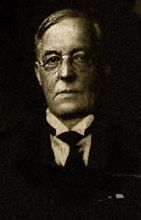
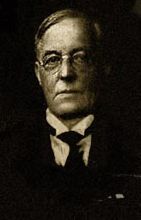
Pictured: M.R. James, 'Father Of The Ghost Story', whose interest in exploring relics in historic French churches seems to have led him to a disturbing conclusion about the nature of their secrets ... Because of the blog’s title, I thought it might be worth looking into a recent theory regarding the secret of Rennes-le-Chateau as a lost codex. The theory concerns how M.R. James, ‘the Father of the Modern Ghost Story', launched his writing career after a visit to a village in the Rennes-le-Chateau area. James was a scholar, a Cambridge academic, whose field was paleography: the study of old documents such as mediaeval manuscripts, which were often collected and bound as codices – sewn together in the manner of a scrapbook. He wrote nonfiction books on church art and architecture, and apocryphal Biblical lore. He also specialised in the ‘antiquarian ghost story.’ Old manuscripts, codexes, and other documents are often a plot springboard of MRJ’s ghost stories, used to create verisimilitude – via what
The Wordsworth Companion To Literature refers to as ‘scholarly details.’ His first-ever story, ‘Canon Alberic’s Scrap Book,’ was written just after he visited a church not far from R-L-C in 1892. This spring, in
Fortean Times, Nick Warren argued that the story was based on rumours then in circulation about what Abbe Sauniere had found at nearby Rennes-le-Chateau that made him rich. If this is so, the story is of interest due to its early date, contemporary with the life and times of Abbe Sauniere, and long before the now-so-familiar modern R-L-C theories appeared. Did he by chance hear the original, contemporary version regarding what Sauniere had found?
The story’s setting is an ex-cathedral church in the same region of France as Rennes-le-Chateau,
St Bertrand de Comminges. The church was built by the local Bishop who became the Pope who had helped destroy the Templars, and one of whose descendants lived in R-L-C Castle. Her sepulchre, says Warren, gave Sauniere clues to the hidden treasure - whatever that was.
Could this treasure have had any link with the HBHG mystery? Was there any connection between this part of France and the Holy Lands in the post-Crucifixion period, when apostles were said to have fled to Europe, bringing holy relics? The Jewish historian Josephus, who wrote two historical accounts after he was captured during the Jewish revolt in Galilee and became a Roman citizen, said that when the pro-Roman Herod Agrippa was made king of the Jews, Rome exiled one of Herod the Great's surviving sons there in AD 39. (Herod Agrippa was Josephus’s source for much of his historical writings.) This unwanted heir was retired to the family estate in a remote part of the Roman province of Spain. The Rennes locality of course is not in modern Spain but is nestled in the foothills of the Pyrenees forming the present Spanish-French border. He was exiled to the Roman colony-town of Vienne, near Lyon north of Massilia (Marseilles). Massilia was the landfall port for Palestian and other traders following the overland tin-trade route across Gaul to southwest Britain, and so is on our ‘grail trail’ in relation to Joseph of Arimatheia et al. Laurence Gardner’s 2005 book
The Magdalene Legacy cites Stewart Perowne’s 1958 book
The Later Herods [Ch 10, p69] as the authority on this, which itself cites Josephus’
Wars Of The Jews that both sons of Herod the Great were exiled to this area. (Josephus was the earliest writer to mention Jesus and his brother and successor James, though later manuscript alterations by church fathers are suspected. For the page references in Josephus, see the Wikipedia entry for
Herod Antipas, which also explains the manuscript copyist’s France-Spain geographical confusion.) The other surviving son, Herod Antipas, who ruled Galilee at the time of the Crucifixion, was also exiled in AD 39, ending up in … St Bertrand de Comminges - the same village MRJ wrote of. This corner of France was what other writers have characterised as a ‘Jewish Princedom’, the colony building up after the massive Jewish revolt Josephus wrote of as the Jewish Wars, which ended with the fall of Jerusalem in AD 70. Whether any relevant relics like Galilean Biblical manuscripts came with these exiles however remains an unanswered question.
The MRJ story has a frightened local sacristan or verger gladly selling the narrator a rare scrapbook-codex of centuries-old pages, together with a plan of the cathedral encoded with magic symbols, which the now-dead Canon Alberic tried to interpret to search for lost treasure. It also has a drawing of Solomon facing down the demon or dragon who guards the Temple gold. This ‘appalling effigy’, an Old Testament demon, then materialises to the new owner of the manuscript when he takes off his crucifix. In another story, ‘The Treasure Of Abbot Thomas,’ the antiquarian storyteller deciphers a biblical code sequence hidden in the artwork of an old chapel, leading to a treasure behind a keystone, again guarded by a ghoul. In fact, most of MRJ’s subsequent stories had a similar setup. Told in the first person as if the events had actually happened to the author or to a friend of his, a travelling scholar or antiquary happens on some papers or treasure, possessing which unleashes some occult force. Usually, a shadowy figure begins to stalk him, leading to death, madness, or flight. The plot setup obviously had a great impact not only for James but for others, for his stories have never been out of print since 1904.
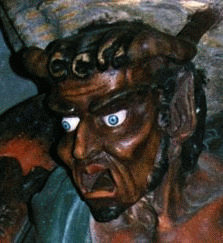
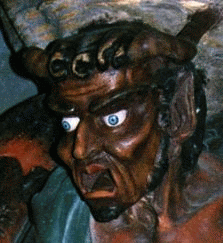
Nick Warren implies Sauniere had a vision of such a ghoul, commemorated in the vivid full-colour sculpture of the swarthy, red-eyed horned-demon painted wooden sculpture seen in the R-L-C church, and now on various websites [
pictured], where the Latin inscription over the door says 'Terrible Is This Place.’ He speculates what Sauniere may have found was such a scrapbook-codex containing old pages with heretical (Templar?) content that would have embarrassed the Vatican, allowing him to overcome his demons, accumulate vast wealth, rebuild the church and, supposedly, leave architectural clues dotted around the landscape. While demonic hauntings do not figure much in the modern round of R-L-C books I have seen, the Templars were certainly accused of consorting with a demon whose head they worshipped. This may be why the label
le tresor maudit or ‘the accursed treasure’ was used by Gerard de Sede as the title for the first of these modern books. Of course, if it was a codex-scrapbook of pages culled from old manuscripts, the question remains, what could have been there that was so frightening? Whatever the Sauniere secret was, it certainly seems to have upset the church - there's a story Sauniere was even refused absolution on his death-bed when he confessed his secrets. The Church tended to denounce heretical works as creations of the Devil, which could explain how the idea of a demon came to be associated with such a mystery.
Clive Prince & Lynn Picknett's recent
The Sion Revelation [p251] notes other published authors seem to have heard rumours about the Rennes-le-Chateau mystery around this time: e.g. the Arsene Lupin novels [1907-] of Maurice Leblanc, where Lupin is in plots
'that can appear unsettling when we know the story'; and Jules Verne's 1896 adventure
Clovis Dardentor, where the hero has the first name of a Merovingian king and a surname said to mean "of the descendants' gold" (using the same root as Plant-Ard). And in Huysmans’s notorious 1891 novel of Satanism in 19th-C Paris,
La-Bas, the setting includes the strange Church of St Sulpice which features in
The Da Vinci Code.
The controversial
Dossiers Secrets, which
HBHG was largely based on, refer to a curse - hence the title of de Sede's book,
Le Tresor Maudit - The Accursed Treasure. (The "worst" swear-words a Catholic can utter are
maudit tabernacle.) The message Henry Lincoln decoded (this is how the whole
HBHG enterprise began) from the parchments reproduced in de Sede's book,
A SION EST CE TRESOR ET IL EST LA MORT could be translated similarly to mean
‘At [Mt] Sion is this treasure and it is Death.’ As Prince & Picknett put it,
"the treasure in some way brings death", the parchment
‘cursing the miscreant who dares steal a fragment of this treasure'. The solution to the now-famous parchment's riddle mentions both Poussin, the painter of the Arcadian scene, and a demon guardian.
Les Dossiers Secrets say that the 7th-C Merovingian dynasty, on losing power to the Carolingians, hid their treasure in this area. A curse was put on it to protect it, which was what supposedly caused Sauniere to fall from grace, be put out of a job in 1910 by his Bishop, and be ordered to Rome to face charges. He had introduced 'satanic' elements into the church which his mysterious wealth had rebuilt, such as having the stations of the Cross run counter-clockwise, and the demon pictured holding up the water stoup. He also had a dog he named Faust, after the character who sold his soul to the Devil in exchange for mortal advantage.
Of course the motto made famous by Poussin,
Et Ego In Arcadia, said to be on a tombstone Sauniere covered up, can refer to Death or any other figure one whould not expect in Arcadia. The motto appeared in an 1832 travel book on the area by a friend of Victor Hugo's, which also referred to the "Devil's treasure" being there. Another aspect suggested by Sauniere’s odd behaviour is that if the documents he found referred to some terrible secret about Christianity such as that Jesus had survived, been married, perhaps had children, then this discovery in itself would be akin to a curse, for how could a man of the church carry on with his duties while keeping such a terrible secret?
Further Reading & Viewing: If you want to explore this approach further, Nick Warren’s article ‘An Accursed Treasure’ is in
Fortean Times #206 [Feb 2006 – article not archived online yet]. The magazine also carried a feature by Picknett & Prince in their July issue, #212. For a commentary on the "demonology" of "Canon Alberic's Scrap-book", see the online essay
The Nature of the Beast by Helen Grant. Even if you’ve never even heard of Montague Rhodes James, you may still have come across his work via a film or TV adaptation. (On the other hand you may just
think you’ve seen adaptations because his work has been so widely imitated.) The most famous film version is the 1958 classic
Night Of The Demon directed by Jacques Tourner, based on MRJ’s story ‘Casting The Runes.’ (In it, an Aleister Crowley type of figure discovers the terrible price that must be paid after he conjures up a demon using an old book of spells he stole from the British Museum.) A 1989 Italian horror film scripted by Dario Argento,
La Chiesa (English title
The Church), was inspired by ‘The Treasure Of Abbot Thomas.’ On TV, the first seems to have been a 2-part dramatisation of ‘Canon Alberic’s Scrap Book’ directed by Tony Richardson in 1954. BBC did a famous b&w adaptation of MRJ’s tale of a dangerous Templar relic, “Whistle, And I’ll Come To You, My Lad” directed by Jonathan Miller, available on DVD from the BFI, with excerpts viewable
online). From 1971-8, BBC-TV produced 5 MRJ ghost stories as part of its annual “A Ghost Story For Christmas” series, including ‘The Treasure Of Abbot Thomas’ and ‘A Warning To The Curious’. The latter is the most famous of the 5, and is available on DVD from the BFI. The stories were meant to be read aloud at social gatherings, and make natural source material for radio and talking-book adaptations, of which there are many. For links to etexts, click
here [
scroll down] or
here. ‘Canon Alberic’s Scrap Book’ is
here, and there is a study-guide PDF to it
here [
right-click to download]. MRJ’s story and own visit to St Bertrand de Comminges is discussed in ‘The Jamesian Traveller’ series on the MRJ fansite,
here. Fortean Times March 2007 issue says MRJ’s work came out of copyright at the end of 2006, and a ‘flurry’ of new adaptations is expected.